ShurIQEditorial · Issue 001Interactive ViewBitMine at $10,000 ether · Research closed October 31, 2026
ShurIQ · Editorial · Issue 001
Ethereum's planned rails are online. The capital has not come back yet.
Five upgrades of the Ethereum network activated on the dates announced for them, the last on December 3, 2025, and the median rollup fee fell from about 20 cents to under a cent. In the month to October 31, 2026, $1,607.2 million left US spot ether funds, and BitMine, the largest holder of ether, traded at 0.837 times what it holds.
DeFi lending, payment rails, tokenized funds and AI agents paying for compute now settle on the same layer, and the last cycle showed deposits moving from near zero to billions in months once rails and demand met. We're testing a thesis here, specifically Ethereum and BitMine, the firm currently sitting on the largest dragon's hoard of it in the market. This report is really just the tip of the ShurIQ iceberg, turning the intelligence engine's graph of this particular thesis into a snapshot report.*
* Be sure to look at the footer of the report for how to import the data and have your favorite LLM work with you in the attached spreadsheet.
SubjectBitMine Immersion Technologies and EthereumEvidencePublic record, research closed October 31, 2026ByShurIQ, Shur Creative Partners
6,051,933 ether
BitMine's holdings, October 25, 2026
0.837
The premium on everything BitMine holds, October 30, 2026; below 1.0 is a discount
$100 to $104
Value of the ether behind each share in a $10,000 ether scenario, on the two share counts
56,900 ether
Room under BitMine's self-set 5 percent ceiling on October 25, 2026, about four weeks of buying at October's pace (derived)
01
What BitMine isI
Staking produced 98.3 percent of BitMine's revenue in the quarter to May 31, 2026.
BitMine is 6.05 million ether inside a company that sells its own shares to buy more. The share count it sells against was last filed on July 9, 2026.
BitMine Immersion Technologies reported 6,051,933 ether on October 25, 2026, 4.953 percent of the 122,175,846 in existence, 86.4 percent of it staked (company-asserted, release filed October 26, 2026). The filed count is 5,416,945 ether at May 31, 2026; trackers repeat the company's figure. Staking earned $45.743 million of the $46.535 million of revenue in the quarter to May 31, 2026; the immersion business in the company's name earned the other $0.8 million. It is a staked ether position with a mining name.
The position was bought with new shares. The at-the-market program, which sells shares as it goes, allows up to $24.5 billion. It sold 340,748,312 shares for $11.869 billion net in the nine months to May 31, 2026, an average of $34.83 (derived from the quarterly filing). Equity raised since June 30, 2025 is $20.46 billion or more, plus $280 million of gross proceeds from 9.50 percent preferred stock. Since July 14, 2026 the company reports buying its own shares back at an average of $17.48 (company-asserted).
The share count is the number a holder cannot get. The last filed count is 603,226,394 shares as of July 9, 2026, or 580,326,394 after 22.9 million of reported buybacks through October 25, 2026. Every 2026 weekly release omits the count (search of 76 company releases, October 31, 2026). From July 12 to October 25, 2026 the company reported about $686 million of ether purchases and $399.6 million of buybacks. Reported cash rose $32 million. About $1.05 billion of that outlay has no disclosed source. Unreported share sales would raise the count, so every per-share figure here prints on both filed bases.
The stock closed at $20.18 on October 30, 2026, a market value of $11.71 billion on 580,326,394 shares, 0.837 times the value of everything it holds. The company sold shares at $34.83 to build the position and buys them back at $17.48. This is not investment advice.
02
How the stock moves with etherII
From July 31, 2025 to October 30, 2026, the falling price investors paid for each dollar of BitMine's net assets cut its stock more than ether's own fall did.
The stock is three numbers multiplied: ether's price, the ether behind each share, and the premium the market pays for the wrapper. Which one is in charge depends on the stretch.
From July 31, 2025 to October 30, 2026 the stock fell from $34.64 to $20.18. Ether's price alone would have cut it 39 percent. The premium alone would have cut it 56 percent. The rise in ether per share alone would have multiplied it by 2.2 (derived; the July 31, 2025 share count is an estimate). Over the full fall, the premium did more damage than ether did.
Over short stretches ether is in charge. Across the 63 common trading days from August 1 to October 29, 2026 the stock moved 1.069 percent for each 1 percent in ether. Ether explained about 55 percent of its daily changes (derived from Yahoo Finance closes). The rest is the stock's own swing, about 49 percent a year, as large as ether's own 50.4 percent.
The premium on everything BitMine holds first closed below 1.0 on November 19, 2025, after a 2025 peak estimated at 1.7 to 2.0. It bottomed at 0.829 on July 13, 2026, last closed at or above 1.0 on September 3, 2026, and closed below 1.0 on 184 of 209 trading days in 2026.
Below 1.0 the financing loop runs backward. When BitMine sells shares to buy ether, ether per share rises if the premium is above 1.0 and falls if it is below. At 0.837 every new share buys less ether than it gives away. That is why the company stopped selling shares at $34.83 and started buying them at $17.48.
In the scenario at the October 30, 2026 close, BitMine would issue a share at $20.04 that holds $23.19 of ether.
Executive Chairman Thomas Lee said on October 7, 2026 that the stock was 90 percent correlated with ether and that BitMine was one of four treasury companies trading above net asset value. The daily correlation over the 90 days to October 29, 2026 was 0.740, and on the day he spoke the premium on everything it holds read 0.892. The direction of his claim holds. The size does not.
03
Head to head with SharpLinkIII
On October 30, 2026 the market valued SharpLink, another listed ether holder, at a deeper discount to its holdings than BitMine.
SharpLink, the other listed ether holder, moves with ether at the same slope and trades at a deeper discount. The market discounts the wrapper at both companies.
Over the 63 trading days from August 1 to October 29, 2026, a 1 percent change in ether came with 1.069 percent in BitMine and 1.093 percent in SharpLink (derived). On October 30, 2026 the market paid 0.837 for BitMine's holdings and 0.715 for SharpLink's. Same asset, same slope, both below 1.0.
They differ on size and on what is on file. BitMine has 580,326,394 shares after reported buybacks, a $24.5 billion share-sale program, preferred stock with a $350 million liquidation preference, and $20.46 billion of equity raised since June 30, 2025. SharpLink had 217,223,604 shares on August 3, 2026, a $6.0 billion program, no preferred and $2.09 billion raised (filings). BitMine files a weekly ether count. SharpLink last filed 888,938 ether at August 3, 2026, and a search of the Securities and Exchange Commission's database on October 31, 2026 found no SharpLink current report after August 10, 2026. At the October 30, 2026 premiums, five $1 billion share sales would cut BitMine's ether per share 4.77 percent and five $100 million sales would cut SharpLink's 7.59 percent. The loop is shut for both.
BitMine carries the larger disclosure risk. Its quarterly filing states its disclosure controls were not effective at May 31, 2026. It paid Eth Tower, an outside manager, $37.5 million in the nine months to May 31, 2026 under a ten-year agreement. At 08:44 UTC on October 31, 2026 the commission's database held no annual report for the year to August 31, 2026 and no late notice. SharpLink's risk is ownership: Consensys Software sold all 5,676,952 of its shares at $8.39 on October 8, 2026.
In a $10,000 ether scenario BitMine holds $104.28 of ether per share and SharpLink $40.92. At a premium of 1.0 that is $103.89 against $38.97 per diluted share. At each company's October 30, 2026 premium it is $87.20 against $27.86 (derived). Strategy, the listed bitcoin holder, is the pattern both follow. Its preferred stock and debt stand ahead of its common shares in size. BitMine's $350 million preferred liquidation preference is small against $14.0 billion of net assets.
Bitcoin beats Ethereum on Monetary dynamics, by 3.75 points, and on money from US spot funds and futures.
Ethereum scores 77.47 of 100 and leads the other twelve chains. It wins where the network is used and loses where Wall Street's money goes.
The Structural Scorecard rates thirteen chains on data for October 1 to 31, 2026 across Settlement demand, Monetary dynamics, Capital access and Ecosystem gravity. A fifth dimension, Roadmap and narrative credibility, has no public series and is unscored. Ethereum's 77.47 places it in the second-highest grade, Strong Ecosystem Player (70 to 84).
On use the gap to bitcoin is wide. Settlement demand is 94.64 to 16.00. From October 1 to 31, 2026 Ethereum's base layer collected $23.33 million of fees against bitcoin's $6.63 million. It hosted $141.73 billion of dollar tokens against none tracked for bitcoin (DefiLlama, October 31, 2026). Ecosystem gravity is 89.98 to 17.91, on 51.72 percent of the value locked in decentralized finance against 7.19 percent. Eighty layer 2 networks, rollups that post their records to Ethereum, hold value on it (L2BEAT).
On money the gap runs the other way. US spot funds have taken in $57.05 billion for bitcoin and $12.32 billion for ether since launch, 4.63 to 1 (Farside, through October 30, 2026). Chicago Mercantile Exchange futures open interest was 2.61 to 1 in dollars on October 27, 2026. Ethereum's Capital access score is 46.91. Monetary dynamics is 88.86 to 92.61. Issuance runs at about the same pace, 0.87 percent a year for ether and 0.84 for bitcoin, and bitcoin's 30-day volatility was lower, 29.30 percent against 36.99. The thesis under evaluation rests on use. The price has followed the money.
The lead survives the fairest test the data allows. Three metrics score bitcoin at zero for want of a monthly series: Lightning, bitcoin rollups and shipped upgrades, the last of which was Taproot on November 14, 2021. Remove them and bitcoin reaches 62.53, with Ethereum ahead by 14.94. Remove the four rollup metrics only Ethereum can score and Ethereum scores 74.08, still first. Under both cuts the lead is 11.55.
Two things keep the score honest. On fees Ethereum ranks fourth, behind Hyperliquid, Tron and Solana, and on Monetary dynamics fourth of thirteen. Developers sit outside the score and are falling: 8,922 monthly active on October 22, 2026, down 53.3 percent from June 15, 2025, still 3.27 times Solana's count (Open Dev Data).
DTCC and Swift built their 2026 settlement systems on Canton and private ledgers, and neither uses Ethereum's main network.
Ethereum hosts the dollars. Wall Street's record keepers run Ethereum's software on ledgers of their own, and nothing dated for 2027 names the base layer.
On October 31, 2026 Ethereum held $141.73 billion of stablecoins, or dollar tokens, 47.41 percent of all chains, down from $163.96 billion and 53.86 percent on December 31, 2025 (DefiLlama, third-party). Over the twelve months to September 30, 2026 the base layer collected $202.2 million in fees, down 79.7 percent on the year. That is about 0.07 percent of ether's $273.7 billion market value, or 74 cents a year for every $1,000 of ether. The dollars are there. The fee they pay is small.
From October 1 to 31, 2026, rollups paid the base layer $9,229 in blob fees and $76,207 in settlement costs (growthepie, third-party).
The verified base-layer record from a Wall Street name is two JPMorgan products. Its deposit token launched on Base, an Ethereum rollup, in November 2025 and went live on mainnet for institutional clients on October 19, 2026. JLTXX, its tokenized government money market fund, launched on public Ethereum on May 13, 2026 with $100 million of seed money (JPMorgan Asset Management release). Both settle in dollars.
The record keepers went elsewhere. DTCC, the company that records who owns US securities, launched its Tokenization Service on October 28, 2026 on Canton and its own private Besu network, with 20 participants (company-asserted). Besu is Ethereum's software run privately by one operator. Swift readied its own Besu ledger with 17 banks on July 9, 2026. Of the three venues that gave notice under the Securities and Exchange Commission's tokenized-stock exemption, effective September 17, 2026, one chose an Ethereum rollup and two chose other ledgers. None chose mainnet. Of tokenized value that moves on chain, Ethereum held 38.6 percent on October 31, 2026, down from 49.9 percent on June 26, 2026 (RWA.xyz).
The test for 2027 is a named launch on mainnet. The GENIUS Act, the federal stablecoin law, takes effect on January 18, 2027. A 21-institution bank consortium targets a dollar stablecoin for the first half of 2027 and names no chain (Santander release, September 1, 2026). DTCC names Stellar and Arc for 2027. Ethereum's own next upgrade, Glamsterdam, was 123 days past its first-half 2026 target on October 31, 2026, with mainnet launch December 2026 at the earliest and no date set. Nothing dated for 2027 names Ethereum mainnet (search of public sources, October 31, 2026). A 2027 launch on mainnet by a licensed issuer, the consortium, DTCC, a venue or a second bank would be the sign; the same launch on Canton, Stellar, Arc, a private ledger or a rollup would be the opposite sign.
Every dated 2027 event is a law, a bank product or a venue approval.
Where recognition would show
Each kind of institution has its own way of recognizing the network's use, and each leaves a different trace. The table lists examples, not predictions. Section 11 maps the full space.
Who
What would count as recognition
Where it would show
Banks and deposit-token issuers
A second named product on mainnet after JPMorgan's two.
A release and the contract address on a chain explorer.
Market infrastructure: DTCC, Swift and the venues
A dated 2027 launch that names mainnet, and not only Besu, Canton, Stellar, Arc or a rollup.
A company release and the contract.
Asset managers and corporate treasuries
A tokenized fund or treasury settlement whose fees settle on mainnet, or on a named Ethereum rollup that settles to the base layer.
An issuer filing or fact sheet.
Payment companies
A dollar token or payment rail that gives Ethereum's settlement cost or speed as the reason for its chain choice.
Product documentation.
AI-native businesses
Agents or markets that need cheap, fast settlement and publish Ethereum or one of its rollups as the rail.
A launch post and a fee table.
Developers and rollup teams
Sustained blob use, with the lower fees passed through to users.
growthepie and L2Beat.
06
The macro chainVI
By October 29, 2026 a 0.10-point rise in the 10-year real yield went with about a 0.6 percent fall in ether, and a 1 percent rise in the dollar index with about a 4 percent fall.
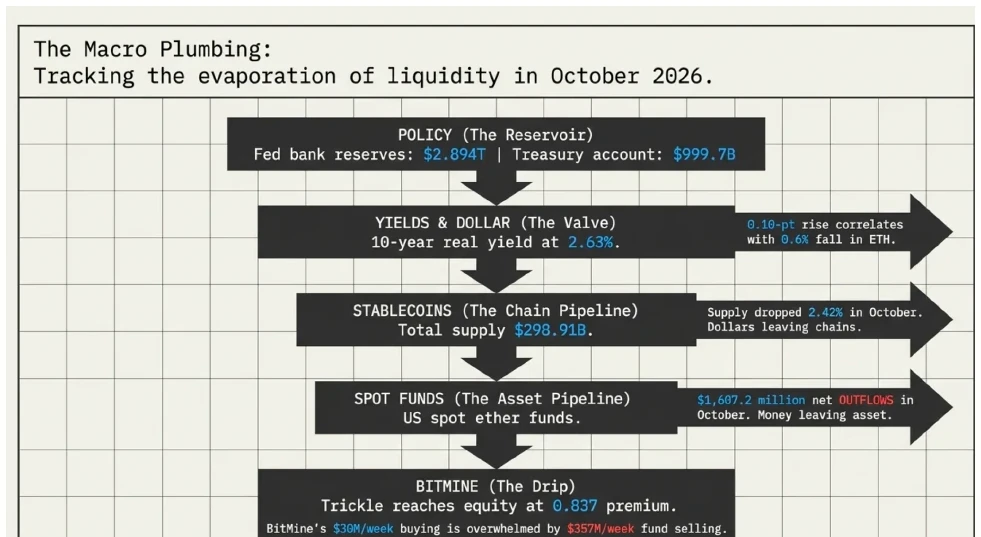
Ether's price runs on a chain of dollars that starts at the Fed and ends at BitMine. In the month to October 31, 2026 the dollars at every link flowed out of ether, and ether traded as bitcoin at a beta of about 1.2.
Money reaches ether in steps, from the Fed's balance sheet through real yields and the dollar, onto chains as stablecoins, into ether through the funds, and last of all into BitMine. One chart per link.
The chain in the month to October 31, 2026. Bank reserves were $2.894 trillion and the Treasury account $999.7 billion on October 28, 2026. The 10-year real yield was 2.63 percent on October 29, 2026. Dollar tokens stood at $298.91 billion, down 2.42 percent in the month. US spot ether funds lost $1,607.2 million. BitMine, at a premium of 0.837, bought about $30 million a week against about $357 million a week of fund selling. Slide: NotebookLM digest of the report's key findings.
Policy and cash
The Fed's total assets were $6.746 trillion on October 28, 2026, $571.5 billion of them Treasury bills (Federal Reserve Bank of St. Louis data).
The Treasury's account held $999.7 billion and bank reserves stood at $2.894 trillion on October 28, 2026. Over the prior 90 days the account rose and reserves fell. The Fed's overnight reverse repurchase facility held $4.4 billion on October 30, 2026.
Real yields and the dollar
Since March 25, 2026 each 0.10-point daily rise in the 10-year real yield has gone with about a 2 percent fall in ether on average; by October 29, 2026 the same rise went with about a 0.6 percent fall. Over the same 90 days a 1 percent rise in the dollar index went with about a 4 percent fall in ether. Real yields lead the chain, and their pull on ether weakened through the year. The dollar index comes second, and its pull held over the 90 days.
The 10-year real yield stood at 2.63 percent on October 29, 2026.
Dollar tokens
Stablecoins fell 2.42 percent across all chains in the month to October 31, 2026 (DefiLlama). Tether reports holding $132.4 billion of Treasury bills on September 30, 2026 (company-asserted attestation). Dollars left the chains in October.
Dollar tokens across all chains stood at $298.91 billion on October 31, 2026, below their May 17, 2026 peak of $315.54 billion. Tron held $93.85 billion of them on the same day.
Fund flows
US spot ether funds had net outflows on each of the five days from October 26 to October 30, 2026, $155.7 million on the last (Farside Investors). Bitcoin funds ended October 2026 down $515.9 million. Stakers moved the other way: 1,302,487 ether waited to start staking on October 31, 2026, against 246 waiting to leave (validatorqueue.com). Holders are locking ether while the funds sell it.
Investors pulled $1,607.2 million from US spot ether funds from October 1 to 31, 2026, the worst month of the year. They had added $1,851.5 million from August 1 to 31, 2026 and $831.3 million from September 1 to 30, 2026. The year's net flow fell to minus $30.9 million.
BitMine
In the week to October 25, 2026 BitMine bought ether worth 0.210 percent of its market value (derived from the company's weekly release). The premium it trades at decides whether each week's purchase adds ether per share or takes it away.
Ether fell 16.53 percent over the 30 days to October 31, 2026.
Bitcoin and ether
Through all of it ether traded as bitcoin: 221 days in the current stretch at a correlation of 0.90, and a 30-day beta of about 1.2 on October 31, 2026 (Yahoo Finance closes). One ether bought 0.05212 bitcoin on November 1, 2023 and 0.02904 on October 31, 2026, 44 percent less. Nothing in this chain prices the network's use. That is the gap between what Ethereum does and what ether costs.
In a $10,000 ether scenario with the stock priced at exactly its net assets, a diluted BitMine share is worth $103.89.
At $10,000 ether the holdings behind a BitMine share are worth about $104, and the premium decides what the market pays for them.
The scenario grid
In the $10,000 ether scenario a diluted share is worth $103.89 at a premium of 1.0 and $87.20 at the October 30, 2026 premium of 0.837; in the $12,000 scenario, $103.96 at that premium. A rise in ether from the October 30, 2026 close of $2,241.05 to $10,000 lifts the scenario value 4.3 times, from $23.94 to $103.89, with the premium held at 1.0. The premium's own observed range moves it 2.1 to 2.4 times. Price does about twice the work the premium does, and the premium still decides what the market pays.
Ether price
Ether per share 580.3M / 603.2M shares
Value per share at a premium of
0.8
0.829 2026 trough
0.837 latest
1.0
1.5
1.758 2025 peak, est.
2.5
$1,500
$15.64 / $15.05
$13.02
$13.49
$13.62
$16.27
$24.41
$28.61
$40.68
$2,241.05 October 30, 2026 close
$23.37 / $22.48
$19.15
$19.84
$20.04
$23.94
$35.90
$42.08
$59.84
$5,000
$52.14 / $50.16
$41.97
$43.50
$43.92
$52.47
$78.70
$93.32
$132.71
$10,000
$104.28 / $100.33
$83.34
$86.36
$87.20
$103.89
$155.83
$182.63
$259.71
$12,000
$125.14 / $120.39
$99.37
$102.97
$103.96
$124.21
$186.31
$218.36
$310.52
Cells are scenario arithmetic on the company’s reported inputs, in value per diluted share. The count starts from 580,326,394 shares and adds 4,500,000 share awards, 359,124 options and 10,435,430 warrants once the share price clears their strike. Ether per share shows both share counts.
At $10,000 ether the scenario value per share is $83.34 at a premium of 0.8 and $259.71 at 2.5.
Staking and issuance
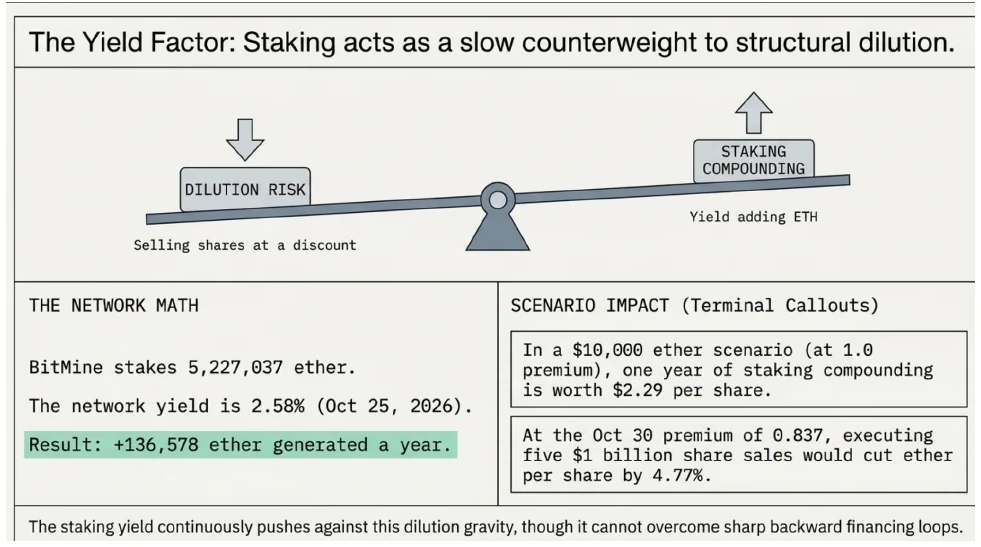
BitMine's 5,227,037 staked ether at the company's 2.58 percent yield of October 25, 2026, set against share sales below a premium of 1.0. The $2.29 a share is one year of compounding in the $10,000 ether scenario at a premium of 1.0. Slide: NotebookLM digest of the report's key findings.Staking at the company's 2.58 percent yield of October 25, 2026 adds about 136,578 ether a year.At the October 30, 2026 close and premium, five $1 billion share sales would cut ether per share by 4.77 percent. At a premium of 1.0 the same sales add 0.86 percent. At $10,000 ether, even a premium of 2.5 adds under 5 percent.
Two share counts
On the last filed count of 603,226,394 shares the $10,000 scenario value at a premium of 1.0 is $100.04; with every dilutive instrument exercised for nothing it is $103.39. The grid forecasts no ether price, premium or share price. Each cell holds the ether count and the share count at their October 25, 2026 values.
Of the thesis's seven claims, three hold with a condition attached, two weaken on the evidence, and two cannot be tested yet.
The thesis that ether beats bitcoin holds on network design and on use. It fails on price and on money from US spot funds.
The report evaluates the following thesis, stated as seven claims, against the public record.
The two untested claims wait on dated events: an ether close above $4,831.35, and a 2027 event that names mainnet.
The claim
The record through October 31, 2026
What the claim assumes
Verdict
Ethereum's base layer can run Wall Street settlement.
DTCC (October 28, 2026) and Swift built on Canton and private ledgers running Ethereum's software. Of three tokenized-stock venues, one chose an Ethereum rollup and two chose other ledgers.
Banks and funds settle on Ethereum's base layer itself.
Weakens. A narrower claim holds: Ethereum is the largest public host of dollar tokens and tokenized funds, and one bank runs on mainnet.
Ethereum's adoption becomes visible in 2027.
Glamsterdam was 123 days late with no mainnet date on October 31, 2026.
Dated 2027 launches on Ethereum's base layer.
Cannot be tested yet.
Ether reaches a new high of $10,000 to $12,000.
Ether funds had net outflows of $1,607.2 million in the month to October 31, 2026.
A close above the $4,831.35 high of August 22, 2025 comes first.
Cannot be tested yet. $10,000 is a scenario input, 4.46 times the October 30, 2026 close.
BitMine's stock tracks ether predictably.
The premium on everything it holds closed below 1.0 on 184 of 209 trading days in 2026.
The stock stands in for ether.
Holds, with a condition. The stock follows ether's direction, at a beta of 1.069 from August 1 to October 29, 2026. Since July 31, 2025 the premium has moved the stock more than ether has.
Ether and bitcoin are different assets.
A 30-day correlation of 0.949 on October 31, 2026.
Because ether and bitcoin work differently, their prices behave differently.
Holds, with a condition. Stakers earned 2.59 percent a year on October 31, 2026 (ultrasound.money, network rate), and bitcoin pays holders nothing. The two prices still track each other: ether's 30-day beta to bitcoin was 1.199.
Ether has far more utility than bitcoin.
Fees came to about 0.07 percent of ether's value over the twelve months to September 30, 2026. Monthly active developers fell 53.3 percent from June 15, 2025 to October 22, 2026.
Heavier use of the network raises what ether is worth to its holders.
Holds, with a condition. Without the metrics only one side can score, Ethereum still leads bitcoin by 11.55 points. Whether holders gain from that use is still open.
Ether is the better asset.
Spot fund inflow ran 4.63 to 1 for bitcoin through October 30, 2026.
More use makes ether the better asset.
Weakens. Over the year to October 30, 2026, ether fell 41.77 percent and bitcoin 29.60.
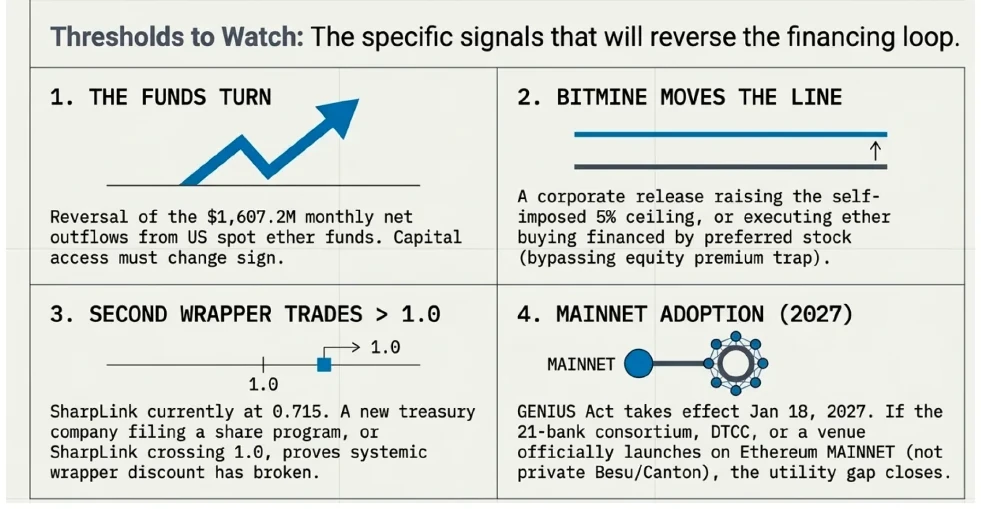
In the month to October 31, 2026, ether fund outflows of $1,607.2 million and a 2.42 percent fall in stablecoin supply both passed their thresholds.
Two of the three thresholds crossed in the month to October 31, 2026 are money leaving. Every threshold on where dollar tokens and tokenized securities settle stayed uncrossed, and the largest buyer of ether says it stops at 5 percent of supply.
Three thresholds crossed
Ether funds had net outflows of $1,607.2 million from October 1 to 31, 2026 against a threshold of $563.8 million (Farside Investors, third-party). Stablecoin supply across all chains fell 2.42 percent in the month against a threshold of 0.69 percent, the year's fourth such month (DefiLlama, third-party). Base-layer fees over the 90 days to October 31, 2026 came to $48.93 million, above the $34.60 million of the prior quarter, inflated by $11.15 million from the two days of the Binance theft.
Thresholds still uncrossed
Ether closed at $2,241.05 on October 30, 2026, against its high close of $4,831.35 on August 22, 2025. Its 90-day beta to bitcoin read 1.207, above the 1.0 threshold. JPMorgan is the one Wall Street bank on mainnet, against a threshold of two. BitMine's latest filed share count is still dated July 9, 2026. All four 2027 quarterly signals were unchanged on October 31, 2026; the condition board lists them.
Public-company ether buying
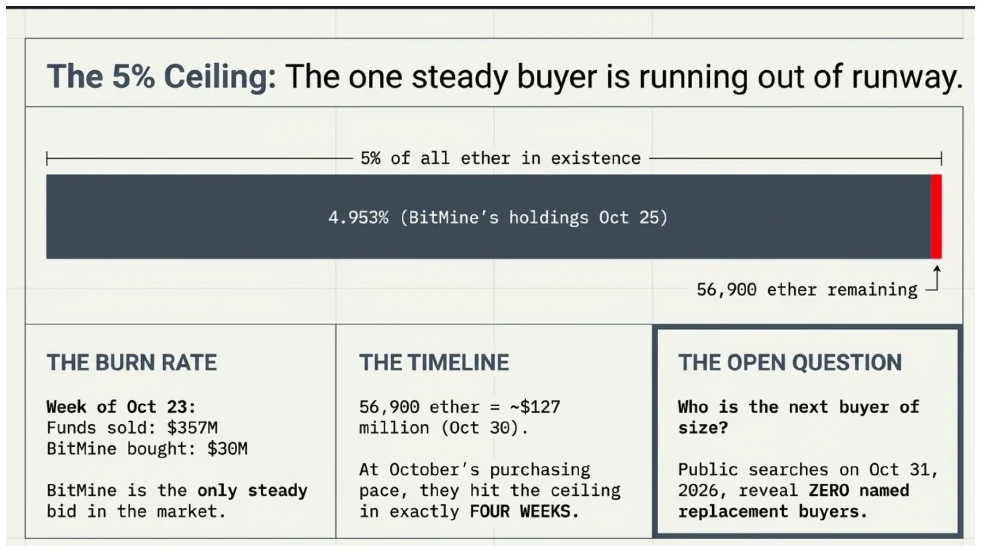
Public companies held 7,849,398 ether on October 31, 2026, 6.42 percent of supply, and BitMine held 77.10 percent of that (The Block's data series, third-party). BitMine's Executive Chairman said on October 7, 2026 that buying stops at 5 percent of supply (company-asserted), and the company held 4.953 percent on October 25, 2026. In the month to October 23, 2026 ether funds sold about $357 million a week against about $30 million a week of BitMine buying (Bits and Bips, press, October 23, 2026). A search on October 31, 2026 found three public analyses that measure this shortfall and none that names a replacement buyer. The buyer that carried 2026 is almost at the line it drew for itself, and no one has stepped up behind it.
BitMine's room under its own ceiling on October 25, 2026 was about 56,900 ether, about $127 million at the October 30, 2026 close, about four weeks of buying at October's pace (derived from the company's release filed October 26, 2026 and the Bits and Bips flow figures of October 23, 2026).BitMine's holdings on October 25, 2026 drawn against the 5 percent line, with the week of October 23, 2026 and the October 31, 2026 search beneath. Slide: NotebookLM digest of the report's key findings.
What would change the reading
Each of these is a fact that can be checked on a date, with a source.
The funds turn. Weekly net flows into US spot ether funds are the first signal, and the condition board already carries them as a row.
BitMine moves its own line. A release raising the 5 percent ceiling, or buying financed by preferred stock, which does not depend on the premium.
A second wrapper trades above 1.0. SharpLink has a $6.0 billion share-sale program and closed at a premium of 0.715 on October 30, 2026, so its loop is shut too. A new treasury company filing a share-sale program would be the sign.
A buyer of size is named. The October 31, 2026 search found none. The day a public source names one, the figure above changes.
From September 27 to October 31, 2026, news coverage treated where Wall Street settles tokenized assets and BitMine's discount to its holdings as unrelated stories.
What a 2027 mainnet launch by DTCC or another Wall Street firm would do to BitMine's premium was unanswered on October 31, 2026. No published source connects the two.
The open question
One set of facts concerns where dollar tokens and tokenized securities settle: $141.73 billion of dollar tokens on Ethereum on October 31, 2026, and the 2026 choice by DTCC and Swift of Canton and private ledgers running Ethereum's software. The other concerns what the market pays for the shares that hold 6.05 million ether: 0.837 times the value of everything BitMine holds on October 30, 2026. Treating them as connected is a judgment with no published source behind it. The condition board in section 9 is built to catch the first dated event that connects them.
How the numbers were built
Each figure is public data retrieved on October 31, 2026, or a filing, release or regulator page opened that day, labelled company-asserted, filing, third-party or derived. The Structural Scorecard weights Settlement demand 20, Monetary dynamics 15, Capital access 25 and Ecosystem gravity 20. Every input to the BitMine grid can be changed in the calculator, and every statement that something does not exist cites a dated search.
The grid, the scorecard and the correlations are modeled; the steps from the Fed to BitMine and the 2027 milestones are described. No figure forecasts the ether price, the premium or the share price. BitMine's ether count is the company's own, restated by public trackers, and the share count on October 31, 2026 is unknown.
11
Latent utility and the mapXI
Rollup fees fell about tenfold after Dencun on March 13, 2024.
Five upgrades cut what it costs to settle on Ethereum's rollups, and the DeFi record shows inflows can scale in months once rails and demand meet. This section is a map for watching whether institutions recognize that, with a dated source behind every signal.
Five upgrades on their announced dates
The Merge, Shapella, Dencun, Pectra and Fusaka activated on the mainnet dates ethereum.org announced for them. Glamsterdam, the next one, missed its first-half 2026 target and had no mainnet date on October 31, 2026, as section 5 records.
Upgrade
Mainnet date
What it changed
The Merge
September 15, 2022
Proof of stake replaced mining, and the network's energy use fell by about 99.95 percent.
Shapella
April 12, 2023
Stakers could withdraw.
Dencun
March 13, 2024
Blobs, a cheap temporary data lane for rollups (EIP-4844).
Pectra
May 7, 2025
A higher blob target, smart accounts (EIP-7702), and a validator balance cap of 2,048 ether.
Fusaka
December 3, 2025
PeerDAS, which lets validators verify blob data by sampling, and more blob capacity.
Glamsterdam
No date on October 31, 2026; ethereum.org labels it fourth quarter 2026
Enshrined proposer-builder separation and block-level access lists; 123 days past its first-half 2026 target.
The cost fell with the data lane. Across Ethereum's rollups, the monthly median fee a user paid was about 20 cents for February 2024, about 1.9 cents for April 2024 after Dencun, 0.06 cents for January 2026 after Fusaka, and 0.14 cents for October 2026 (growthepie, third-party, refreshed November 1, 2026). L2Beat listed 94 rollup and layer-3 projects securing $30.15 billion on November 1, 2026 (third-party). Speed is two numbers, and the map keeps them apart. A rollup confirms a transaction in seconds. The base layer makes it final in minutes, and an optimistic rollup's exit to the base layer can take about seven days. Nothing on mainnet settles instantly.
The DeFi record: months, not years
When rails and demand met before, deposits moved in months. DefiLlama's daily record, retrieved November 1, 2026 (third-party), gives the value locked in three Ethereum protocols:
Protocol
Early reading
Later readings
Aave
$54.0 million on May 20, 2020
$1.68 billion on December 31, 2020; $11.20 billion on May 31, 2021
Compound
$605.8 million on June 30, 2020
$1.98 billion on December 31, 2020; $7.15 billion on May 31, 2021
Lido
$1.5 million on December 19, 2020
$743.8 million on March 31, 2021; $1.57 billion on May 31, 2021; $11.74 billion on December 31, 2021
That is the blueprint, and it is a retail one. Institutional use also needs the cost, settlement and compliance rails the upgrades and the rollups improved, and section 5 shows those rails are still, on the record, often private ledgers. Mainnet recognition is a separate, dated signal. Nothing here says BitMine's premium must change.
Agent payment rails
AI agents now have dated payment rails that settle on Ethereum's rollups. Coinbase published x402 on May 6, 2025, an open standard that sends stablecoin payments over HTTP for APIs, apps and agents, and wrote that fees on Base, its Ethereum rollup, had dropped to 1 cent, which is what makes micropayments work (Coinbase Developer Platform). On October 23, 2025 Coinbase launched Payments MCP, which lets a language model open a wallet and pay with stablecoins through that protocol (Coinbase Developer Platform). Google launched the Agent Payments Protocol in 2025 (Google blog, February 11, 2026). Decrypt reported on September 16, 2025 that Coinbase and the Ethereum Foundation backed it, and that the Foundation contributed to its x402 extension. Google donated the protocol to the FIDO Alliance on April 28, 2026 (Google blog). The fee floor these rails assume is the one Dencun set. Whether agent commerce reaches billions of dollars of fee volume in a few months is an observation here, not a dated fact. BitMine holds the ether those rails settle against. It is not an AI company.
The map
The map has four layers. Stakeholders are the six rows of the table in section 5. Rails are mainnet, Ethereum's rollups, private Besu, Canton, and the other chains section 5 names. Catalysts are the protocol upgrades, the GENIUS Act on January 18, 2027, a named mainnet launch, and a change of sign in US spot ether fund flows. Signals are the dated facts that would show a narrative has started.
Solid lines are the record on October 31, 2026: JPMorgan on mainnet and on Base, DTCC and Swift on private Besu and Canton, DTCC's 2027 chains elsewhere. Dashed lines are the signals that would count as recognition. A launch on a private ledger is the opposite sign for the mainnet thesis.
Narrative
Leading signal
Confirming fact
Use recognized on mainnet
A second bank on mainnet; DTCC or a venue names mainnet
Ethereum's share of tokenized value, 38.6 percent on October 31, 2026 (RWA.xyz)
Cheap settlement in use
Blob use and the median rollup fee (growthepie)
The base layer's fee share from blobs
Capital access returns
Weekly US spot ether fund flows turn positive (section 9)
BitMine's or SharpLink's premium back above 1.0
DeFi-speed inflows return
Value locked in Ethereum protocols accelerates (DefiLlama)
Ethereum's share of dollar tokens, 47.41 percent on October 31, 2026
Agents settle on Ethereum
A named agent or market launch that cites rollup fees
Sustained fee revenue on those applications
Reading the map
Keep use and capital apart. Network use is the scorecard, fees and dollar tokens. Capital access is the funds and the premium. The gap between them is the report's own open question.
A narrative is active only with a dated, named source.
Lead with announcements and flow signs, confirm with chain data or a filing.
Reach BitMine only through ether held, the staking yield, the premium and the 5 percent ceiling, the four quantities sections 7 and 9 define. This section adds no valuation.
Record claim, evidence, date and source, the method section 10 describes.
Figures from DefiLlama, growthepie and L2Beat were retrieved on November 1, 2026, and the ethereum.org, Coinbase, Decrypt and Google pages were opened the same day.